
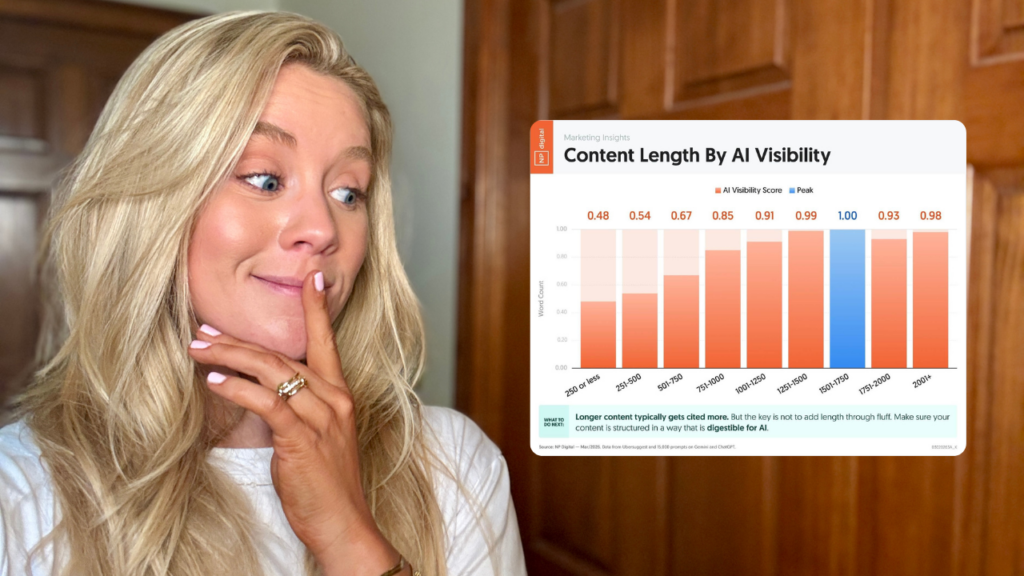
We came across a piece of research from NP Digital recently that stopped me mid-scroll.
Not because it was shocking, but because it confirmed something most businesses are still doing backwards.
Longer content is more likely to be cited by AI. Not shorter, “quick answers,” but long-form blog content with a clear range of where visibility peaks.
The Data That Changes How You Should Write Blogs
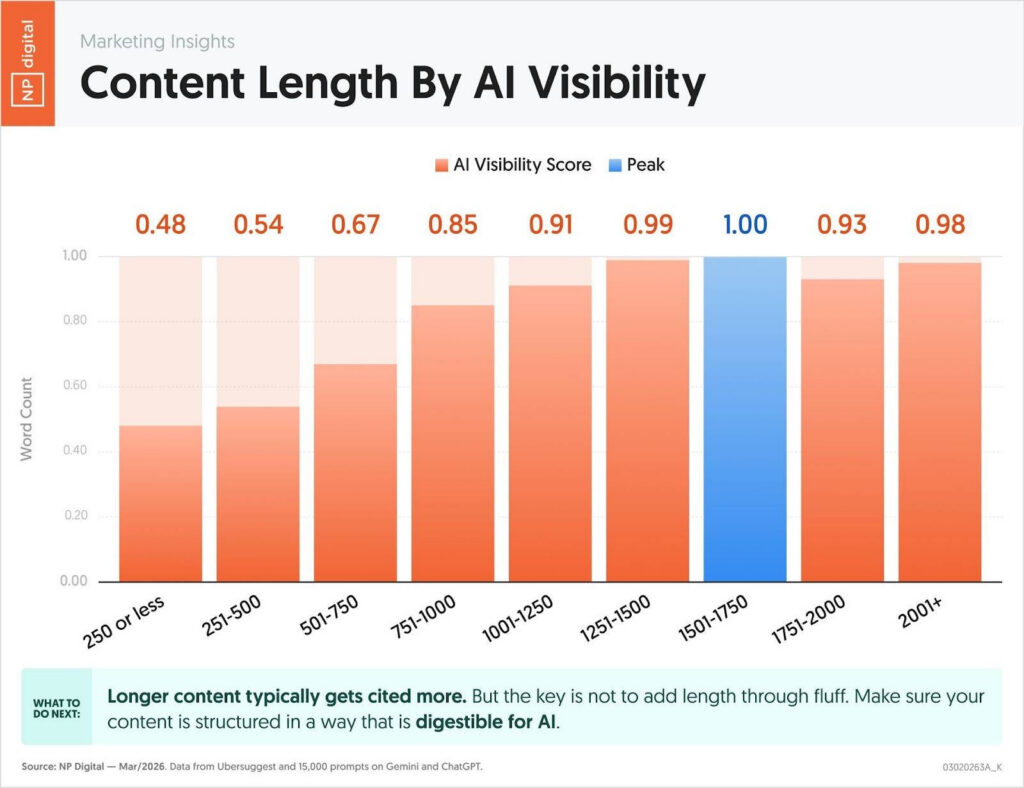
According to NP Digital’s research (analyzing 15,000+ prompts across AI tools like ChatGPT and Gemini):
- AI visibility increases as content length increases
- It peaks around 1,500–1,750 words
- Then slightly tapers, but remains high beyond that
At the same time:
- 60–65% of searches now end without a click
Which means if your content gets cited, you win visibility, but if it doesn’t, you don’t exist in that moment because there’s no “second page of Google” anymore in AI search.
Why Longer Content Wins in AI Search
Most people assume AI prefers short, concise content because it gives short answers, but that’s not how it finds answers.
AI models are trained to:
- Pull from context-rich sources
- Extract clear explanations
- Combine multiple data points into one answer
Short content doesn’t give it enough to work with, but longer content does.
Not just because it’s longer, but because it’s more complete.
What Most Businesses Get Wrong About Blogging for AI Searchability
You may have heard “longer content wins,” and you’d be right, but if you’re also thinking…
“Okay, we’ll just write longer blogs…” You’d be wrong.
That’s how you end up with 2,000 words of fluff that never get cited. Length isn’t the advantage. Extractability is.
AI favors content that is:
- Easy to scan
- Easy to understand
- Easy to pull specific answers from
So the real question is, how do you write content that AI can use?
How to Write Blog Content AI Will Cite
If you’re a small business or startup, you don’t need a massive content team. You just need to structure your content differently. Here’s exactly how we approach it at Breezy.
1. Start With the Exact Question Your Customer Is Asking
AI search is question-driven. So your blog should be too.
Instead of:
“Benefits of Hiring an Electrician”
Write:
“When Should You Replace Your Electrical Panel?” or “How Much Does It Cost to Upgrade Your Panel in Texas?”
AI tools are constantly matching prompts to direct answers. If your blog mirrors the question, you increase your chances of being pulled in.
2. Answer the Question Immediately (Then Expand).
At the top of your blog (or section), include a direct answer in 2–4 sentences.
Example:
Most electrical panels should be replaced every 25–40 years, or sooner if you’re experiencing frequent breaker trips or adding high-demand appliances.
AI doesn’t want to interpret your content. It wants to extract it.
3. Use Clear, Descriptive Headings (Not Clever Ones)
This is not the place to be cute.
Instead of:
“Signs It’s Time for an Upgrade”
Write:
“Signs You Need to Replace Your Electrical Panel”
AI reads headings as structure markers. Think of them like labels for what’s inside.
4. Break Content Into “Pullable” Sections
Each section should feel like it could stand on its own.
That means:
- Short paragraphs
- Bullet points when helpful
- One clear idea per section
You don’t want long, dense paragraphs covering multiple ideas.
You do want something like a section titled “Cost to Replace an Electrical Panel” with a direct answer + supporting details.
5. Add Depth Without Adding Fluff
This is where most people lose.
To reach that 1,500–1,750 word sweet spot, you need to go deeper, but not broader.
Add:
- Examples
- Real scenarios
- Comparisons
- Common mistakes
- Specific numbers or ranges
Avoid:
- Repeating the same idea
- Generic filler language
- Over-explaining obvious concepts
6. Include Multiple Angles on the Same Topic
AI doesn’t just pull one sentence, because it builds answers.
So your blog should include:
- Definitions
- Step-by-step explanations
- Costs
- Pros/cons
- FAQs
This gives AI more ways to use your content.
7. Write Like You Talk (But Structure Like a System)
This is where founder-led content wins.
You don’t need to sound like a textbook.
But you do need to be:
- Clear
- Direct
- Organized
The tone builds trust, but the structure earns visibility.
The Shift Most Businesses Haven’t Made Yet
A lot of companies are still writing for keywords, rankings, and click-through rates
But AI search is changing the game. Now you’re writing for inclusion in the answer itself, and that’s a completely different goal.
What I’d Do If I Were Starting From Scratch
If you’re a small business or startup, here’s the simplest way to start:
- Take your top 10 customer questions
- Turn each into a blog post
- Aim for 1,200–1,800 words
- Structure it for extraction (not just readability)
- Answer clearly, then expand with depth
Do that consistently, and you’re not just creating content, you’re creating sources AI can trust and cite.
Shift the Way You Write for AI Search
The businesses that win in the next version of search won’t be the ones creating the most content. They’ll be the ones creating the most usable content.
Right now, most people are still optimizing for the wrong thing, but at Breezy, we’ve already made this shift. If you’re ready to get more value out of your blog and leverage it to get cited in AI search results, reach out to our team today.